Loading notes...
Notes could not load.
Questions
a) General description — clinical, biomedical or mixed study?
- Clinical study: A 12-month randomized controlled trial (RCT) conducted in Guangzhou, China.
- Compared time-restricted eating combined with calorie restriction against daily calorie restriction alone.
- Observer-blinded: Outcome observers were unaware of participants' group assignments, but participants knew which diet they followed.
- No separate laboratory-based experimental component involving cells or animals.
b) Were patients included? Describe the study groups.
139 adults with obesity were randomly assigned to two groups.
| Characteristic | TRE | DCR |
|---|---|---|
| Participants | 69 | 70 |
| Mean age | 31.6 years | 32.2 years |
| Mean weight | 88.4 kg | 87.9 kg |
| Mean BMI | 31.8 | 31.3 |
| Men | 52.2% | 50.0% |
Selection criteria:
- Age 18–75 years and BMI 28–45 kg/m2.
- Recruited through advertisements and community screenings.
- Excluded patients with diabetes, serious cardiovascular disease, significant liver or kidney disease, and certain other conditions.
Interventions:
- TRE: Calorie restriction with eating limited to 8 AM–4 PM.
- DCR: Same calorie targets without restricted eating times.
- Both groups received dietary counselling for 12 months.
c) Were there any animal studies?
No. The research involved only human participants. No animal models were used.
d) Was ethical approval obtained?
Yes.
- Approved by the Institutional Review Board of Nanfang Hospital, Southern Medical University.
- All participants provided written informed consent.
- Registered on ClinicalTrials.gov as NCT03745612.
- The trial was overseen by a steering committee.
e) What statistical methods were used?
- Intention-to-treat analysis: Participants were analysed according to their originally assigned groups.
- Mixed-effects models: Used to compare changes between groups while accounting for repeated measurements over time.
- Multiple imputation: Used to handle missing data from participants who did not complete all assessments.
- 95% confidence intervals: Used to express uncertainty in estimated treatment effects.
- p-values: A two-sided p < 0.05 was considered statistically significant for the primary outcome.
- General linear models and chi-square tests: Used for comparisons of continuous and categorical outcomes, respectively.
Main statistical finding:
The estimated difference in weight loss was −1.8 kg (95% CI −4.0 to +0.4 kg; p = 0.11).
Because the confidence interval includes zero and p > 0.05, the researchers did not find a statistically significant advantage for time-restricted eating.
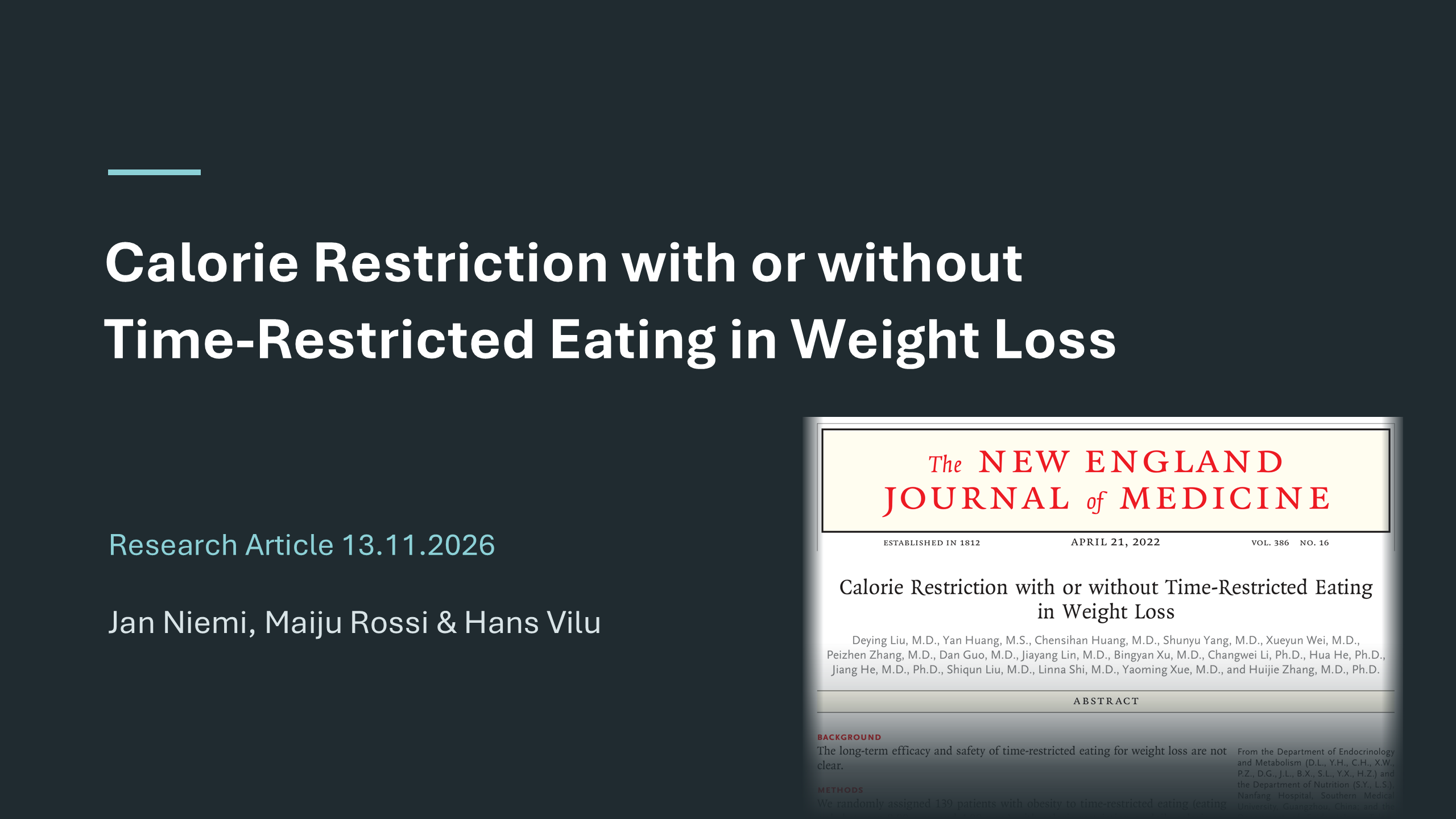
Source: Liu et al., 2022, NEJM — Methods and Results.